Designing Effective Town Hall Meeting Banner Templates
When you're organizing a community forum, a local government update, or a neighborhood association meeting, the first impression is often visual. The banner you hang at the entrance or share on social media sets the tone before a single word is spoken. A well-designed template isn't just a time-saver; it's a foundational piece of your event's communication strategy. The right design asset conveys professionalism, clarity, and an invitation to participate. For designers, marketers, and small business owners tasked with these community-facing projects, having a reliable, high-quality starting point is invaluable. That's precisely where a versatile resource like this template shines, offering a professional foundation that can be adapted to any civic or organizational context.
Anatomy of a Professional Event Template
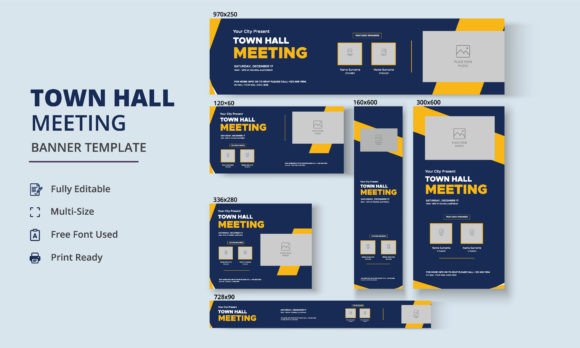
This particular set of Town Hall Meeting Banner Templates is crafted with a clean, modern aesthetic. It avoids overly complex or trendy design elements that might date quickly, favoring instead a balanced composition that prioritizes information hierarchy. The visual personality is one of clarity and approachability—think of it as the professional yet friendly face of your event. It likely uses a harmonious color palette that can be easily adjusted to match your organization's brand identity, ensuring consistency across all materials. The layout is structured to guide the viewer's eye naturally from the event title to the key details like date, time, location, and host information. This kind of thoughtful structure is what separates a mediocre flyer from an effective piece of graphic design.
The true power of this template lies in its flexibility. Being an Adobe Illustrator file means every single element is editable. You're not locked into a static image. Need to change the main headline font to better match your city's official typeface? Simple. Want to swap the background image to a local landmark instead of a generic cityscape? Done. This level of customization is critical for maintaining brand perception and professionalism. A cookie-cutter template can make your organization look impersonal, but a customizable one allows you to inject your unique brand identity into the design seamlessly. It’s a premium font and design asset experience without the premium custom-design price tag.
Practical Applications Beyond the Meeting Room
While the primary use is clear, the applications for a versatile civic template extend far. For a marketing agency, this template becomes a reusable asset for any client involved in community engagement, from a real estate developer hosting a project update to a local business sponsoring a charity drive. For a blogger or content creator covering local politics or community events, it can be adapted into social media graphics that announce live streams or recap key takeaways. The design's professionalism lends credibility to the content.
Consider a small business owner who also serves on a local board. They can use the template to create banners for board meetings, ensuring their personal brand is represented with the same care as their business brand. The print-ready format at 300 DPI resolution is a major practical benefit. It means the same file you use for a digital flyer on Facebook can be sent directly to a print shop for a large-format vinyl banner without any loss of quality. This consistency between digital and print assets is a hallmark of a strong brand identity, reinforcing recognition whether someone sees the event online or in person.
Choosing and Customizing with Purpose
Selecting a template like this is the first step. The next is evaluating its fit for your specific project. Before you even open the file in Adobe Illustrator, gather your brand assets: your logo, official color codes, and preferred fonts. This preparation makes the customization process quick and efficient. Test font pairings within the template's structure. If the template uses a bold, modern display font for the title, consider pairing it with a clean, highly readable sans-serif font for the body details. This contrast creates a clear visual hierarchy, ensuring the most important information—the "what" and "when"—is instantly legible even from a distance.
When editing, apply the same critical eye you would to any design project. Is the text too crowded? Adjust the leading and kerning. Does the color scheme feel off-brand? Use the color picker to input your exact hex codes. The note that "all images are just used for preview purposes only" is a standard and important reminder. It underscores that you are licensing the design framework and layout, not the specific stock photos. This is where you inject your own visual content—photos of your actual team, your building, or relevant community imagery. This transforms the template from a generic asset into a genuine piece of your organization's editorial design and visual storytelling.
Finally, always consider the end viewer. A banner for an indoor community center might have different readability needs than one for an outdoor street fair. Test your design by viewing it at a small size on your screen to simulate how it might look as a social media thumbnail. Print a test section to check color accuracy and text sharpness. By approaching this template not as a final product but as a professional starting point, you leverage its strengths—easy customization, print-ready quality, and a solid design foundation—to create something that truly serves your project's goals and resonates with your audience. It’s a practical tool for anyone serious about effective community communication and polished visual branding.